Why a Defender Watches the Space as Well as the Ball
Learn how a defender reads the space behind and beside an opponent to choose when to hold position, close down or protect a passing route.
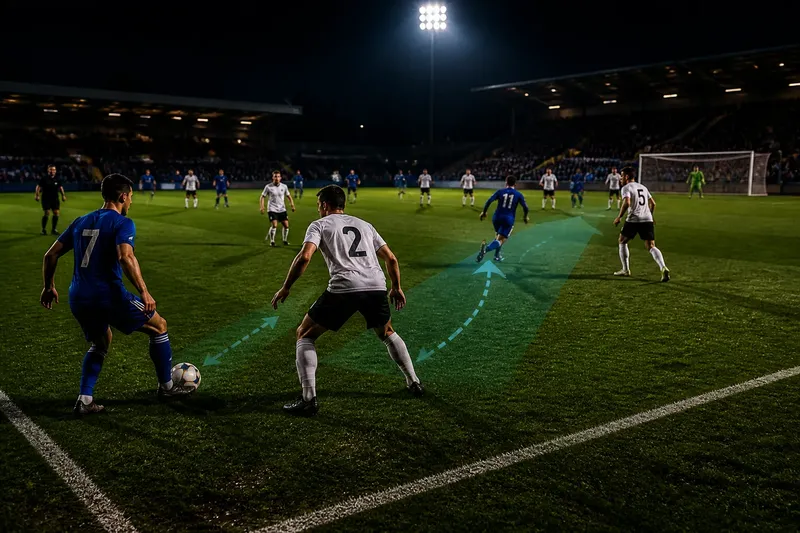
A winger receives the ball near the touchline, and a defender takes a half-step towards them. But the midfielder behind the winger is already moving into the channel between that defender and the centre-back. The ball is the obvious threat; the space opening behind it may be the more urgent one. Reading that space is a core part of defending, in football and in many other invasion games.
A defender is not simply trying to stand close to an opponent or chase the ball. They are weighing which useful space an opponent could reach next, and how their own position might make that route awkward. Over a week of ordinary viewing or practice, you can learn to spot those choices by watching one small area at a time.
Start by choosing one space to watch
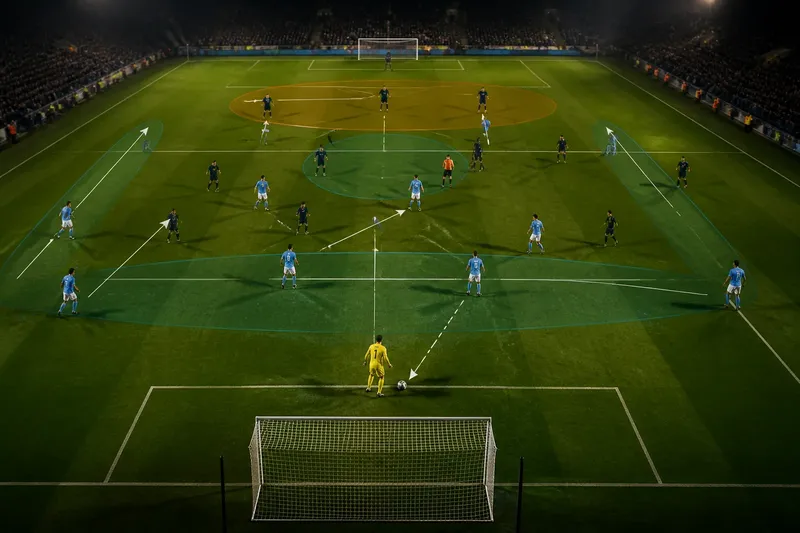
Before a match, pick a simple landmark: the channel between a full-back and centre-back, the gap in front of a goal, or the open side behind a midfielder. These spaces matter because an attacker can use them to receive a pass, turn towards goal or draw a defender out of position.
For a week, spend a few minutes on one game or training session following that landmark rather than trying to track every player. Notice who is closest to it, which opponent might want to enter it, and whether the ball carrier can see the route. You are building a picture of the relationships, not memorising a formation.
On the first viewing, keep the question narrow: if the ball moved now, who would be in danger of receiving it in that space? On another occasion, ask what would happen if the defender nearest the ball stepped forward. A space can become vulnerable even before anyone runs into it.
Read the defender’s position relative to the route
A defender’s position makes most sense when you compare three things: the opponent, the useful space and the likely passing route between them. Standing between an attacker and the space can discourage a run or make a pass harder to play. It does not necessarily mean the defender should stand directly in the passing lane; a slight angle can leave them ready to react to either the ball or the runner.
Look at the defender’s body orientation as well. If they can see both the ball and the opponent, they have more information than if they turn their back to one of them. A side-on stance often helps a player move in either direction, though the best position depends on the speed and angle of the threat.
Distance matters, but there is no single ideal gap. Too much distance may leave an attacker time to receive and turn; too little can let that attacker slip past with one touch. The defender is judging how quickly the ball could arrive and whether help is close enough to cover the space behind.
Follow a week-long viewing routine
Use the same small routine across several sessions. Each viewing has a different job, so the details build without turning the match into a blur of moving shirts.
- First session: mark the landmark. Choose one gap and watch which players occupy or threaten it. Note when it looks protected and when it appears open.
- Second session: follow the nearest defender. Watch how their position changes as the ball moves away, towards them or across the pitch. Ask whether they are keeping a route covered or preparing to challenge.
- Third session: watch the attacker’s movement. Look for a short check towards the ball, a run behind the defender or a pause that pulls the defender out. The attacker’s movement can create a passing option without receiving the ball.
- Fourth session: include the supporting defender. Notice who could cover if the first defender steps forward. A teammate’s position may make an aggressive challenge sensible, or leave the space too exposed.
- Final session: replay one sequence in your mind. Start just before the ball moves and trace the defender’s choice: hold, shift, close down or hand the opponent to a teammate. Identify the space each choice protects or risks.
If you are practising on the pitch, work through the same observations at a walk during an ordinary, non-contact drill: identify a space, take a position that can see the ball and runner, then adjust as a teammate moves the ball. Keep the exercise focused on awareness and movement, not on tackling or physical confrontation.
Decide when to hold, shift or close down
Holding position can be the right choice when an opponent is threatening a dangerous route and the ball carrier has few safe options. The defender may stay between the runner and the space, rather than rushing towards the ball and opening a lane. That restraint can look passive on a quick replay, but it may be what keeps the attack in front of the defence.
Shifting across is useful when the ball moves and the threatened space changes with it. Defenders often adjust together so that one player does not leave a gap for an opponent to exploit. The important clue is not that everyone moves in the same direction, but that they keep useful distances and cover the routes that remain available.
Closing down can make sense when the ball carrier is under pressure, has a poor angle or is about to take a touch that limits their options. Yet a defender who charges without cover can be bypassed, leaving the space they meant to protect open. The decision depends on what the ball carrier can do next and who is positioned to deal with the consequences.
Say a defender is several steps inside the touchline while an opponent controls the ball wide; a second attacker begins a run into the channel behind them. If the defender moves straight at the ball, the runner may have a clear route into that channel. If a teammate is already covering the runner, the defender may be able to press; if not, holding a position that screens the route could be the more useful choice. The observable difference is whether the attacker can receive in the space facing forward or is forced to move elsewhere.
Separate a deliberate choice from a missed cue
One frame rarely tells you whether a defender made a good decision. Follow the sequence from just before the pass to the moment after it: was the defender looking at the runner, did the ball carrier have time to play the pass, and was a teammate covering? The answer often depends on information that only becomes clear across several seconds.
Also notice what the attacker achieved without touching the ball. A run can draw a defender away, allowing someone else to use the space. Conversely, an attacker can occupy a defender simply by standing in a threatening position, reducing the defender’s freedom to help elsewhere.
When reviewing your own play, use a brief question rather than a verdict: “Which route was I trying to protect?” If you cannot answer, check whether your attention stayed on the ball throughout. The aim is not to label every movement right or wrong, but to connect position with the threat it was meant to address.
What should you look for in a defensive sequence?
Should a defender always stand between an attacker and the goal?
Not always. The relevant space may be a passing lane, a channel behind the defence or a route towards the sideline, and a teammate may already be protecting the direct route to goal.
Why might a defender leave an opponent unmarked?
They may be prioritising a more dangerous space or keeping a better angle to respond to the ball. Check what the opponent could do from their position before deciding that the defender has simply lost track of them.
How can you tell whether a defender has cover?
Look for a teammate close enough to respond if the defender is beaten, and for a position that does not leave both players responsible for the same space. If the defender steps forward, the cover player should have a clear route to the threatened area.
Does watching space apply outside football?
Yes. In basketball, a defender may guard a lane an opponent wants to drive through; in hockey, a player may protect the route to the slot while tracking the puck. The game’s rules and spacing differ, but the question remains: which space could become dangerous next?
Keep the observation simple
There is little value in trying to track every player, every pass and every possible route at once. Pick one space, follow the defender responsible for influencing it, and only widen your view when a teammate’s cover changes the decision. That small habit makes the ball’s location easier to interpret rather than less important.
By the end of the week, return to the same landmark and compare what you notice. You may see that a defender’s most telling movement happens before the pass: a quiet shift, a checked shoulder or a step that closes a route without starting a challenge. The ball still drives the play, but the space often explains why the defender moves as they do.