The Formation Number Is Not a Map of Every Position
Understand football formation numbers by tracking how players shift between build-up, attack and defence, and read the team’s shape beyond the starting line-up.
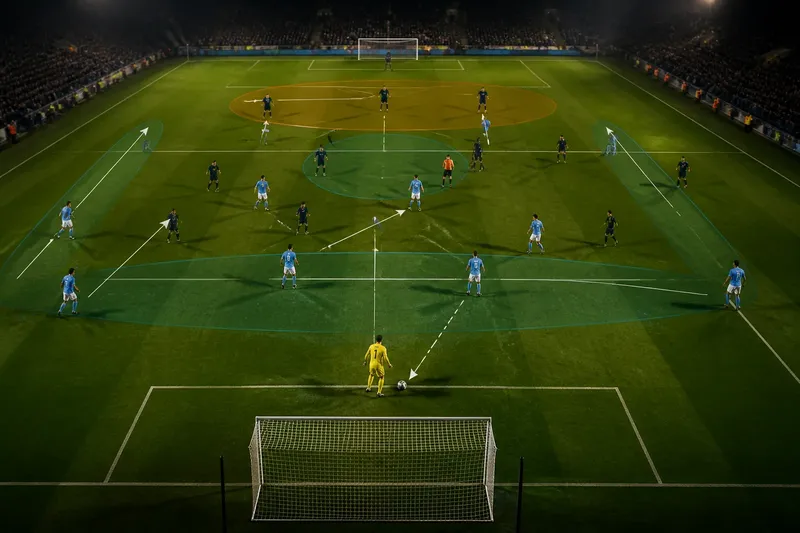
A team is listed in a 4-3-3, but when the goalkeeper rolls the ball out, a midfielder drops between the centre-backs and a full-back steps into midfield. Football formation numbers are useful clues, not maps of where every player must stand throughout a match. To read them well, watch how responsibilities and spacing change with the phase of play.
A formation label is a starting sketch
The numbers usually describe the broad arrangement of outfield players, read from defence towards attack. A 4-3-3 suggests four defenders, three midfielders and three forwards; it is shorthand for the team’s basic shape, not a complete list of individual duties.
Even the starting sketch can shift. A side announced in a 4-2-3-1 may defend with its wide attacking players dropping alongside the central midfielders, making a compact line of four. The same players can spread out when their team has the ball.
Think of the label as a clue about the intended balance: how many players are assigned to each broad line, and where the team may seek support. It cannot tell you the exact distances, the direction of movement, or who is responsible for a particular space in every moment.
Read the shape through the phase of play
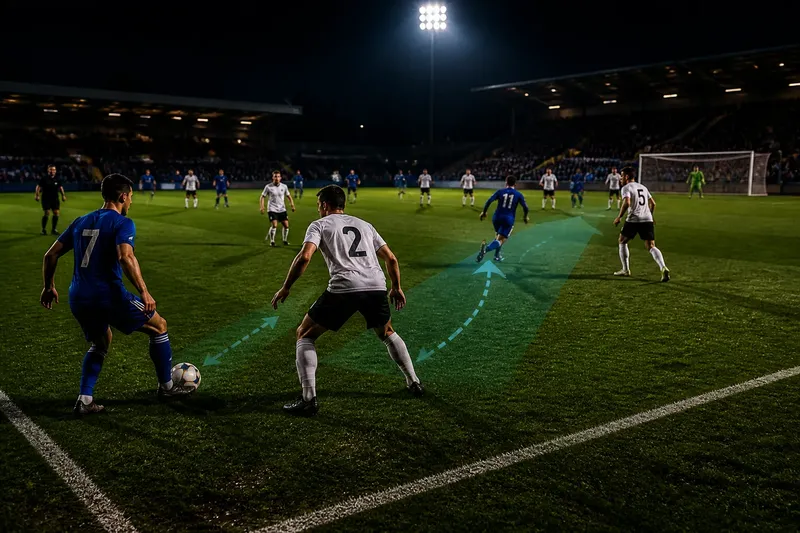
Teams often look different while building from the back, attacking near the opposition goal, and defending without the ball. A player’s position in one phase should not be mistaken for their permanent role.
- Build-up: A centre-back may split towards the touchline while a defensive midfielder drops closer to the goalkeeper to offer a passing option. A full-back might move inside to help carry or circulate the ball.
- Established attack: A winger can hold width, cut towards goal, or rotate with a full-back who runs beyond them. A midfielder may arrive near the penalty area rather than remain in the central lane.
- Defending: The team may retreat into two close banks, with forwards screening passes into midfield. Those forward players still have defensive work, even if the formation label places them in the attacking line.
These movements do not mean the original formation was wrong. They make the shape useful for the immediate problem: finding a passing route, stretching a defence, or closing space when possession changes hands.
Follow responsibilities, not just coordinates
A position is often better understood as a set of responsibilities than as a spot on the grass. Ask who offers an outlet, who protects the space behind an advancing teammate, and who makes the run that pulls a defender away.
That lens also helps explain rotations. If a winger moves inside, a full-back may take the vacant outside lane. The players have exchanged areas for a moment, but their broader jobs remain connected: one threatens the middle, while the other gives the attack width.
Look at what happens after a pass, too. A midfielder who releases the ball may move forward to become an option near the box, while a teammate covers the space they have left. The team’s shape is maintained or altered through those choices, not by players staying planted in their original lanes.
One label can produce several shapes
Imagine a team named in a 4-2-3-1. As an invented situation, suppose its right full-back moves infield during build-up, while the nearest holding midfielder drops towards the centre-backs. The team may now appear to have three players across its deepest line, while the other full-back stays wide.
In this invented situation, the ball then reaches the attacking third: the right-sided forward cuts inside and the full-back advances outside them. If possession is lost, the forward tracks back and the full-back retreats; the team may settle into a more familiar line of four with a midfield screen. The observable sequence is several shapes linked by each player’s next responsibility, rather than one fixed diagram.
When watching, choose one player and follow them across these changes. A formation graphic can identify their starting line, but their movement shows whether they are covering, supporting, pressing, or creating an option.
Small cues reveal what the shape is doing
You do not need to name every tactical system to read movement. Use these observations to decide what to watch next:
- Full-backs: Check whether they advance together or take turns. If both go forward and a midfielder stays behind, follow that midfielder as the cover; if neither covers, watch for the team to hold one full-back back as an alternative.
- Central midfielder: Notice whether one drops alongside the defenders or stays ahead as a passing link. If they drop, track who occupies the space in midfield; if nobody does, watch whether a forward comes short to offer an outlet.
- Wide players: Observe whether they hold the touchline, move inside, or drop to defend. If a winger moves inside, see whether a full-back takes the outside lane; if not, expect the team’s attack to become narrower.
- Forwards after possession is lost: Watch their first movement. If they press the ball or block a passing lane, follow the nearest teammate’s cover; if they recover towards their own goal, look for a midfielder to step forward and press instead.
- Spacing between lines: Compare the gaps between defenders and midfielders with and without the ball. If the lines draw close, look for a compact defensive block; if a gap opens, note whether an opponent drops into it or a defender steps out to challenge.
- Player movement after a pass: Check whether the passer moves forward or stays behind the ball. If they advance, identify the teammate covering their space; if they hold position, watch for another player to provide the next forward run.
It is not worth assigning a new formation number every time a player changes lane. That can turn a flowing sequence into a naming exercise. Describe what you can see first, then use a familiar label only if it helps explain the team’s general arrangement.
Questions that help you read formation numbers?
Do formation numbers include the goalkeeper?
Usually, football formation numbers count outfield players and leave the goalkeeper out of the sequence. The label describes the broad lines in front of the goalkeeper rather than listing every player on the pitch.
Why does a team look different when it has the ball?
Attacking often requires players to spread out, offer forward passing options, and cover space left by teammates who move on. The defending arrangement may be narrower or deeper, so the same team can show visibly different shapes in each phase.
Can two teams with the same formation play differently?
Yes. Their players may have different responsibilities, and the coach may ask them to press, build, or defend in different ways. The number sequence does not specify those choices.
How can I tell whether a player’s role has changed?
Watch repeated actions rather than one isolated position: where the player offers support, what they do after passing, and which space they cover when a teammate moves. A brief swap can be a rotation; a consistent pattern across phases suggests a wider tactical responsibility.
Use the number as a clue and watch the movement
Formation numbers are most useful as a first hint about a team’s structure. Read the football formation number alongside the phase of play, the players’ responsibilities, and the spaces they create or protect.
On your next match, notice one repeated movement, such as a full-back stepping inside or a forward dropping to screen a pass. That small detail can tell you more about the team’s working shape than another string of numbers.