Before the Digital Scoreboard: Keeping Track of a Match
Before the digital scoreboard, handwritten scorekeeping preserved the match’s detail; see what each record reveals, hides and helps a spectator follow.
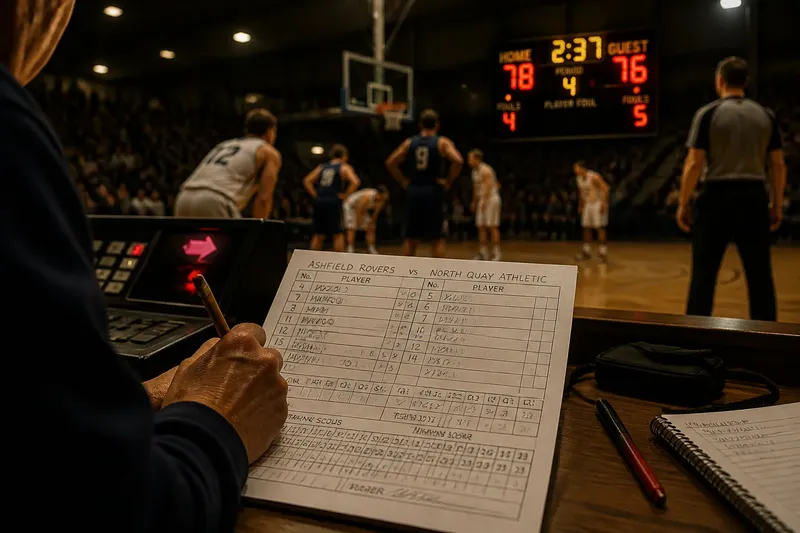
The volunteer at the scorer’s table presses a pencil into a ruled notebook while players reset for the next point. Across the court, a digital scoreboard shows the score in bright numerals, but not the small turn of events that brought the teams there. Before the digital scoreboard, handwritten scorekeeping was the match’s working memory; the contrast still helps explain what spectators can see, and what can disappear from view.
Consider an invented, clearly hypothetical match between the fictional Ashfield Rovers and North Quay Athletic. The game is a low-stakes local basketball fixture, with a volunteer keeping a paper scoresheet and a basic electronic display visible from the stands. The point is not to recreate a particular league’s paperwork: scoring conventions vary, and the official rules and organiser’s instructions determine what belongs on the record.
A paper record follows the match in small marks
Before play, the scorer writes the teams’ names and player numbers into the appropriate spaces. As the game unfolds, the sheet can hold more than a running total: depending on its design and the competition’s rules, it may record points by player, fouls, time-outs, periods and other events. Some marks are made immediately; others are entered in a designated box or confirmed with an official.
That detail gives the paper record a particular character. It can tell a reader not merely that Ashfield leads, but which players have scored or accumulated fouls, and how the total changed across the match. A well-kept sheet offers a compact account of sequence and responsibility, rather than a single answer to “What is the score?”
Its limits are just as visible. A sheet lies flat on a table, uses abbreviations or symbols, and may be hard to read from a seat. It asks the scorer to make decisions and marks in real time, so a missed entry can create uncertainty that a spectator cannot resolve by glancing at the page.
The display turns a record into a public signal
The electronic scoreboard has a different job: show selected information clearly to people who are not standing beside the scorer. In this imagined basketball match, the display presents the score, period and clock. A more capable system might also show team fouls or player fouls, but a basic board cannot be assumed to include every item that an official records.
Large digits make comparison immediate. A spectator can look up from the court and see which side is ahead and how much playing time remains, without decoding a handwritten notation. That quick reading supports the shared rhythm of watching: the crowd can react to a close finish, a run of points or a change in the lead as it happens.
Yet a display is a window, not the whole record. It selects information for fast recognition and leaves out much of the trail behind it. The board may reveal that the score has changed, but not which player earned the points, whether a foul affected a substitution, or how a disputed entry was checked. Those details live elsewhere, if they are recorded at all.
A close sequence shows what each record can answer
Say the invented match is level late in the final period. North Quay scores, Ashfield answers, and then an Ashfield player makes a basket that the scorer initially attributes to the wrong number. The scoreboard changes to show Ashfield ahead. From the stands, the immediate story is clear: the lead has shifted. The player responsible is not.
The table’s paper sheet gives the officials another kind of view. Its player-by-player entries make the attribution visible, while the running score helps them compare the recorded total with the display. The scorer notices the mismatch and asks the appropriate official to confirm the correction under the match procedure. The display is then updated, and the record reflects the agreed entry.
In this hypothetical scene, neither form replaces the other. The board broadcasts the current state; the sheet helps preserve the detail needed to check how that state was reached. If the paper entry had been unclear, the officials might have needed to consult other permitted records or their own observations. No single sheet or screen can settle every disagreement by itself.
The same distinction matters after the final signal. A spectator may remember the winning margin, but a paper scoresheet can retain player totals and fouls that explain who contributed, who had to manage foul trouble, and how the match developed. An electronic display can make the final result easy to share, but it may not retain a complete match history once the game ends.
What does each kind of scorekeeping make visible?
What can a handwritten scoresheet show that a scoreboard cannot?
A paper sheet may preserve player-level scoring, fouls and the order of recorded events, depending on the form used. A public scoreboard usually prioritises the information spectators need at a glance, rather than offering a full account of each entry.
Why do scorekeepers still use paper?
Paper provides a direct record at the table and can be useful for checking entries, following individual player totals and supporting the officials’ process. Its usefulness depends on a legible, timely record and on the form matching the competition’s requirements.
Can a digital scoreboard replace the official scoresheet?
Not necessarily: the visible display and the official record can serve different purposes. The organiser’s rules decide which record has authority, while the scoreboard communicates selected information to players and spectators.
What should a spectator watch if the board seems wrong?
Notice the score, period and clock, then look for whether officials pause play or consult the scorer’s table. A spectator can spot an apparent mismatch, but the decision about correcting the record belongs to the match officials under the applicable rules.
The two records invite different kinds of attention
For a spectator, the board is an instrument of pace. It makes a score change legible before the next passage of play has begun, and the clock can sharpen the meaning of every possession. Its clean surface can also make the contest seem simpler than it is: one number rises while the reasons behind it remain on court or at the table.
The handwritten sheet invites a slower kind of reading. If the organiser makes an authorised record available afterwards, a reader can trace who scored and when fouls accumulated. That does not make the sheet a complete tactical account; it records defined events, not every screen, defensive adjustment or movement without the ball.
Each format therefore shapes memory differently. The board helps a crowd share the present moment. The paper record can preserve selected details for review. Neither captures the whole experience of watching, and neither should be mistaken for a replay or a full description of the game.
How the invented match ends on paper and screen
In the fictional Ashfield–North Quay match, the officials confirm the corrected player entry, and play resumes. Ashfield keeps its narrow lead through the final possession. When time expires, the digital board presents the result clearly; at the table, the scorer completes the paper record according to the organiser’s procedure.
The outcome is the same in both places, but the records answer different questions. The board tells the crowd who won and by what score. The sheet can show which player’s points were entered, which fouls accumulated and how the official account was assembled. For anyone trying to understand the match rather than merely its result, that distinction is useful.
It is not worth trying to copy every notation from a scorer’s table while the game is moving; symbols can be competition-specific, and a spectator’s version will not become an official record. Instead, watch the board for the shared state of play, then notice when the table and officials attend to details the display does not carry. Before the digital scoreboard, the pencil made those details visible on a page; today, the same separation between public signal and fuller record remains worth watching.